


Key Takeaways
- US equities declined following the announcement of China’s cost-efficient Deepseek AI model and growing concerns about a potential tariff war, triggering market uncertainty and a shift away from tech stocks.
- While non-US equities and South African markets performed well in Q1, South Africa faces challenges from new tariff impacts and internal GNU coalition tensions, causing hesitation among international investors.
- Gold emerged as the top-performing asset class as investors sought safe havens amid market volatility, while the US Dollar depreciated.
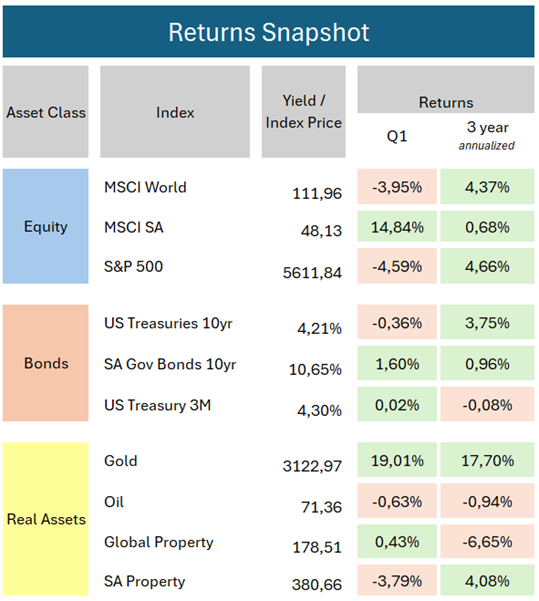
Q1 Market returns
Q1 Economic Review
(as of March 31st)
The US has long been the stronghold for equities, and provided a safe haven in the form of the dollar. And so with the world dependent on the US markets, all eyes would be on the United States as Trump’s first few months in office, as it would have long-reaching effects on developed and emerging markets alike.
What Trump promised did not come to fruition. Instead of the pro-growth, deregulatory-fuelled ‘Trump bump’ we saw in his first term, markets were given tariff-terrorizing uncertainty. Now, a trade war threatens increased inflation and contained economic growth.
Trump’s policies have been extreme. However, it would be unwise to think Trump and his cabinet would have been ignorant of the reaction it has caused. The US president as well as Treasury Secretary Scott Bessent have come stating that they’re willing to endure short-term pain to achieve their policy goals.
It is safe to say that the ‘problem areas’ of the multiasset portfolio remain a geographic one.
The US Federal Reserve kept interest rates steady in their January & March meetings. Fed officials jumped onto the uncertainty bandwagon, along with consumers and businesses, waiting for more policy clarity from the Trump administration.
Eurozone growth remains below US and global averages, but recent tailwinds have improved the outlook. Germany announced a €500B stimulus package, including increased defense spending, boosting regional forecasts. The ECB also delivered two 25 bps cuts, supporting the economy amid global uncertainty and US trade tensions.
Q1 Domestic Review
(as of March 31st)
South Africa wasn’t exempt from Trump’s record number of executive orders and foreign diplomatic tensions. Trump cut aid in early February, citing disapproval of its land expropriation policies.
Later the same month, a delayed budget speech kicked up domestic political tensions.
The released budget speech includes a phased VAT increase from 15% to 16% by April 2026. Personal income tax brackets also remain unadjusted for inflation, creating a “stealth tax” effect as salaries push taxpayers into higher brackets.
The SARB cut rates by 25 basis points (0,25%) in January, and then kept the repo rate at 7.5% in its next meeting in March. By quarter’s end, despite well-controlled inflation, global uncertainty became the primary factor in holding rates steady.
Q2 Economic outlook
(as of April 6th)

The market is still just as uncertain and even harder to predict. However, the threat of a US recession has increased. Tariffs have just been announced.
The results have resulted in JPMorgan economists recently raising their probability for a US recession to 40% as a result of trade policies. And they aren’t alone in their predictions.
Anchor Capital gives three paths from here:
- Recession
- No Recession
- Policy wins
Having just announced reciprocal tariffs, Trump needs policy wins. With his record amount of executive orders, the cabinet has ‘front-loaded’ many of their hardest-hitting policies.
With a possible perspective to get the most impacting policies out of the way to give time for momentum to pick up going into the midterm elections. Some of these wins could come in the form of extending tax cuts, clean energy and environmental policies, and weaker tariff measures.
Q2 Domestic Outlook
(as of April 6th)
South Africa has made significant progress in its efforts to be removed from the FATF grey list. Four out of six outstanding action items were upgraded, paving the way for a potential exit from the grey list in October.
Greylisting has had a direct economic impact, especially on foreign direct investment:
- Increased foreign investment
- Improve its credit rating through global rating agencies: lower borrowing costs for the government, enabling it to access cheaper financing.
Troubles in the GNU have, however, dampened investor confidence. This, combined with Trump’s Tariffs, makes the outlook over the next 3 months very uncertain. Unfortunately, the economy lacks sufficient strength to resist these headwinds.
Equities Review
(as of March 31st)
Global equities have shown modest movement with sector average returns hovering around 2% over the quarter. What truly captured our attention was the resurgence of non-US equity markets.
Non-US equity markets made a comeback. After declining from 47% to just 33% of global market share since 2015, non-US equities staged an impressive recovery. In the first quarter their share climbed to 36%. This turned out to be one of the first signs that US exceptionalism was waning.
Policy uncertainty undermined investor confidence in US growth prospects and equity strength. This hesitation created opportunities elsewhere as capital sought after new homes.
Country-specific developments have also enhanced the appeal of international stocks. Germany’s expansive fiscal spending, Japan’s corporate governance reforms, and Mexico’s emerging role in reconfigured supply chains were all contributing factors.
While the “Magnificent 7” US tech giants stumbled during recent market turbulence, European and Chinese tech sectors have outperformed their US counterparts this year. They’re beginning to narrow the performance gap that emerged after ChatGPT’s November 2022 launch.
This suggests future tech sector growth may become less concentrated in US stocks. The reliance of US equities on tech performance could prove problematic as the sector diversifies globally. Value investors stood to benefit as market concentration decreased out of momentum and growth stocks.
US Equities
U.S. equities began the year reaching new highs before taking an unexpected turn. NVIDIA plunged 13% after hours following China’s Deepseek AI announcement. This new model reportedly matches leading competitors’ performance on just a $6 million training budget.
This poses challenges for NVIDIA, now the S&P 500’s largest stock by market cap, which has already dropped over 30% since the Deepseek news broke.
Markets remained stable until February 20th when Trump announced new tariffs, triggering a 10% S&P 500 decline over three weeks as trade tensions grew. The U.S. equity sector closed down about 2%, suggesting investors should favor selective positioning over broad market exposure.
Eurozone
European markets outperformed globally this quarter, with Eurozone and UK equities leading while US investors worried about trade tensions. Capital has rotated from US tech into European stocks.
European and UK equity funds have been the top performers in offshore portfolios. Investors shifted toward European and Asian markets, which seem better positioned to weather trade disruptions thanks to government fiscal policies.
Valuations are more attractive in Europe than America. Since Trump’s inauguration, European markets have shown resilience, barely reacting when he threatened 25% tariffs on European imports, including automobiles.
Asia
Chinese markets made serious noise. A wave of seemingly more efficient Chinese AI models propelled the Hang Seng index of mainland shares up an impressive 20% this year.
This investor enthusiasm pushed the Hang Seng Tech Index to three-year highs in the quarter as Deepseek made global headlines.
The narrative that China is “uninvestable” simply hasn’t matched market reality. Despite ongoing tensions and regulatory concerns, the performance numbers tell a different story – China remains very much open for business.
Domestic Equity Review
(as of March 31st)
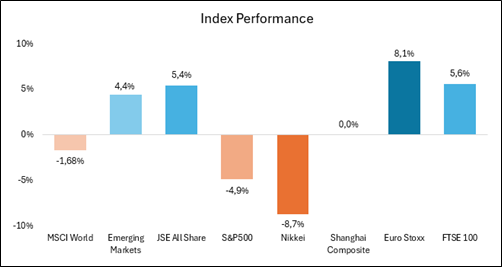
South African equities and emerging markets showed strength in Q1. The JSE All Share gained 5.4%, beating the MSCI EM index‘s 4.4% increase. Emerging markets outperformed developed markets overall, with the MSCI World index declining 1.68%.
This shift reflects growing confidence in emerging economies during uncertain times in traditional markets. Key drivers included Chinese tech stocks surging following DeepSeek AI excitement, uncertainty in developed markets pushing investors to alternatives, and favorable conditions from a weakening dollar and declining US 10-year Treasury yields.
In South Africa, commodity miners led the charge, particularly Gold and platinum as investors sought safe havens. Large caps carried the JSE with 8.6% returns in rand terms, while mid-caps barely broke even at 0.06% and small caps fell 7.07%.
These smaller companies typically indicate SA Inc shares performance (domestic-focused businesses). Allan Gray has warned that many locally-focused stocks may be overvalued after rallying following the Government of National Unity (GNU) formation last year.
Equities Outlook
(as of April 6th)
The first week of April revealed the severe tariff impact on markets, with single-day losses comparable to the 2020 COVID crash. Markets are approaching 20% down from recent highs, nearing bear market territory.
These events are only days old, making reliable quarterly predictions difficult. If recession looms, major indices might be most of the way through their decline. Markets typically reverse course faster than investors can react, even amid dire conditions.
Near-term outcomes remain unpredictable. Will negotiations succeed? Long-term, tariffs decrease economic efficiency since free market principles allow unimpeded trade. Any restrictions reduce productive economic potential.
Before this correction, value stocks appeared undervalued while growth stocks dominated. Value investing should return as risk aversion increases. This strategy has provided resilient picks in current portfolios.
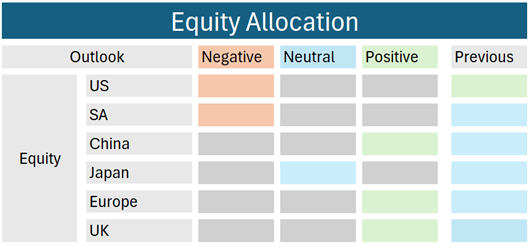
Eurozone equities performed well in Q1 but lost some gains in early April. Despite this pullback, they remain attractive.
Japan didn’t excel in Q1 but has weathered the correction better than most, though still declining. Japanese markets maintain a neutral outlook.
Emerging markets, which gained during Q1, have responded relatively well to tariff announcements, with the MSCI Emerging Markets index down just 1.2%.
South Africa stands as an exception, falling 11.7% in rand terms. While attractive valuations provide some bullish perspective for SA equities, tensions within the Government of National Unity have significantly dampened investor confidence.
Fixed Income Review
(as of March 31st)
The yield curve showed signs of normalizing this quarter. Market sentiment shifted from recession predictions to a no-recession scenario, then back toward recession concerns in the final weeks as policy uncertainty intensified.
Germany’s fiscal regime change created a positive European outlook, driving divergence between US and European fixed-income markets.
US Treasuries performed well, with the 10-year yield falling from 4.5% to 4.2% as weaker economic data triggered risk-aversion purchases.
Meanwhile, South African 10-year yields jumped 1.3% to 10.4% in January, stabilizing at 10.6% by quarter-end due to stalled ANC-DA coalition negotiations over the 2025 budget. South Africa’s approaching 80% debt-to-GDP ratio and unresolved SOE bailouts increased sovereign risk perceptions.

RSA retail bond fixed rates increased across maturities, with the 2-year ending at 9% (up from 8.5%), the 3-year at 9.25% (up from 9%), and the 5-year at 10.25% (up from 9.75%).
Throughout Q1, investors favored high-quality investment-grade bonds and shorter-duration securities as safer alternatives during uncertainty, though yield declines benefited shorter-term bonds less than longer-term securities.
Fixed Income Outlook
(as of April 6th)

Fixed income offers more attractive opportunities than equities as investors seek protection during market weakness. After three years, bonds and stocks are decorrelating again, improving fixed income positioning in balanced portfolios.
For returns outlook, focus on substantial yields available now rather than speculating on capital growth from rate cuts. Current yields offer value regardless of which economic scenario unfolds.
South African bonds carry a negative quarterly outlook due to political tensions and tariff impacts, creating significant headwinds. However, they remain attractive for yield-focused investors, offering some of the highest real yields across government sectors.
US bonds have attracted inflows, but eurozone bonds likely offer superior performance potential. The ECB has greater flexibility on rates compared to the Fed, which faces more inflation constraints.
While projected Fed rate cuts increased from two to four as recession concerns grow, European bonds appear better positioned across credit markets and duration exposure.
Duration typically performs well in weakening markets. With increased US recession probability, longer-duration bonds are well-positioned for strong returns.
If central banks implement further rate cuts, particularly the Fed, we could see a steeper yield curve, favoring longer-duration bonds as investors seek safety and higher yields.
Cash allocations are gradually decreasing, with short-duration instruments potentially offering higher returns than cash with lower volatility than longer-dated securities.
Recently, government bonds have rallied as yields declined, with longer-duration bonds significantly outperforming. Price sensitivity increases with maturity as a 10-year Treasury experiences larger price gains from yield movements than a 2-year note.
Forward Outlook:
- If recession materializes: Expect significant front-end yield declines, continued curve steepening, and outperformance from long-duration bonds. Rate cuts would be substantial across US and European markets, though at different paces.
- If recession is avoided: Rate cuts will continue in Europe but proceed more gradually in the US. The yield curve could flatten if growth fears subside, potentially causing long-term yields to rise. Short and intermediate duration might offer better risk-adjusted returns.
Commodity Review & Outlook
(as of April 6th)
The iShares MSCI World Energy sector ETF delivered strong quarterly performance, showing resilience in traditional energy equities despite market uncertainty.
Gold stands as this year’s top asset, rising over 17.45% to lead all major asset classes. This rally stems from increasing safe-haven demand amid market anxiety, substantial central bank purchasing, and mounting geopolitical tensions.
Copper showed even stronger momentum, with futures prices surging 25.86% during the quarter. Market speculation around potential Trump tariffs on this crucial industrial material has driven much of this price action.
Oil markets faced significant headwinds, with crude falling 2.2% as tariff developments weakened global demand expectations and major producers agreed to production increases.
Currency Allocation
(as of April 6th)

Dollar The dollar isn’t attracting typical risk-off inflows. While treasuries and gold draw capital, the greenback lags behind. We’re seeing outflows, largely due to increasing isolationist policies and accelerating global de-dollarization efforts.
Euro Positive news around fiscal stimulus and de-dollarization has largely been priced in with Q1 movement against the dollar. The currency is still expected to continue its upward trajectory somewhat.
Pound Market focus is shifting from inflation management to growth generation. UK growth expectations remain lackluster, placing sterling in neutral territory for the foreseeable future.
Rand The rand took a significant hit from Trump’s tariffs and political tensions, erasing Q1 gains. After appreciating 4.2% against the dollar, these advances vanished in early April when Trump announced a 30% tariff on South African imports.


